
How to get Free Cavity Wall Insulation Grants?
If you live in the UK, you can get a free Cavity Wall Insulation Grant as part of our comprehensive home energy efficiency scheme. It’s for everyone using benefits such as Universal Credit, Pension Credit, ESA, etc. Getting wall insulation funding is especially beneficial if you own a house (because it is pretty expensive to fund it on your own).
Are you eligible for Energy Company Obligation grant?
As an expert in green energy and sustainable solutions, I firmly advocate for the widespread adoption of renewable energy technologies

What is Cavity Wall Insulation?
A cavity wall is two layers of brick with a cavity between them. Cavity wall insulation or CWI is a process of inserting insulation into a small space between them. Depending on the type of cavity, different materials can be used for the insulation, such as foam, bead, or mineral wool.
But you don’t have to worry about figuring out which one will suit your home. We will send a surveyor to determine whether your property is suitable for government cavity wall insulation (including finding out if cavity wall insulation removal will be needed to replace old insulation in some circumstances) and which one will be most appropriate.
How does Cavity Wall Insulation reduce heat loss?
Cavity wall insulation works by reducing the amount of heat loss from walls. To increase thermal efficiency of the wall, insulation material is blown between the bricks to decrease heat transfer outside the wall.

Step 1
Use the eligibility checker below to determine if you are eligible for the cavity wall insulation grants
Step 2
A member of our Energy Advisor team will contact you to schedule a survey
Step 3
Get a lower energy bill and relax in your improved, energy-efficient home!
Why do Energy Companies Provide Grant for Cavity Wall Insulation Free of charge?
This is due to the Energy Company Obligations scheme (ECO) supported by The Energy Saving Trust and regulated by Ofgem.
Initiated by government free cavity wall insulation UK grants are funded by energy companies, through installers like Eco4 Energy because of the government’s commitment to improving the UK’s carbon emissions. Energy suppliers are obligated to follow the government scheme and put money into making UK homes more efficient because the alternative of getting fines would be far worse, but it’s excellent for their customers!
The Qualifying Benefits for Free Cavity Insulation are:
- Child Tax Credits
- Child Benefits
- Housing Benefit (NEW)
- Income-based Jobseeker's Allowance
- Income-based Employment & Support Allowance
- Pension Credit Guarantee Credits
- Pension Credit Saving Credits (NEW)
- Universal Credit
What is Cavity Wall Insulation Made from?
Free cavity wall insulation used by installers is often made from shredded mineral wool, glass fibre or polystyrene beads, which both reduce the heat escaping from your home by up to 35%.
While cavity wall insulation alone could save you up to £145 each year and reduce carbon emissions by up to 610kg, our integrated energy-saving solutions are designed to maximize your home’s efficiency and savings. Even having partially filled cavity walls is more beneficial than uninsulated cavity walls in the long run.
Is my House suitable for Free Cavity Wall Insulation?
There is a chance that cavity wall insulations won’t be suitable for your home, but here’s how you can tell if your home is suitable:
- The external walls are unfilled cavity walls.
- It has at least a 5cm wide cavity.
- It was built before 1982 and in some cases 2005.
- Your home is capable of heating efficiency in the long run.
- Your property’s brickwork, outer wall or masonry is in good condition.
- There is little risk of your house flooding.
- The walls are not exposed to too much driving rain or extreme weather.
- It is still possible to have it installed even if adjoining properties don’t.

Can Location Impact Getting my Free Cavity Wall Insulation Grants?
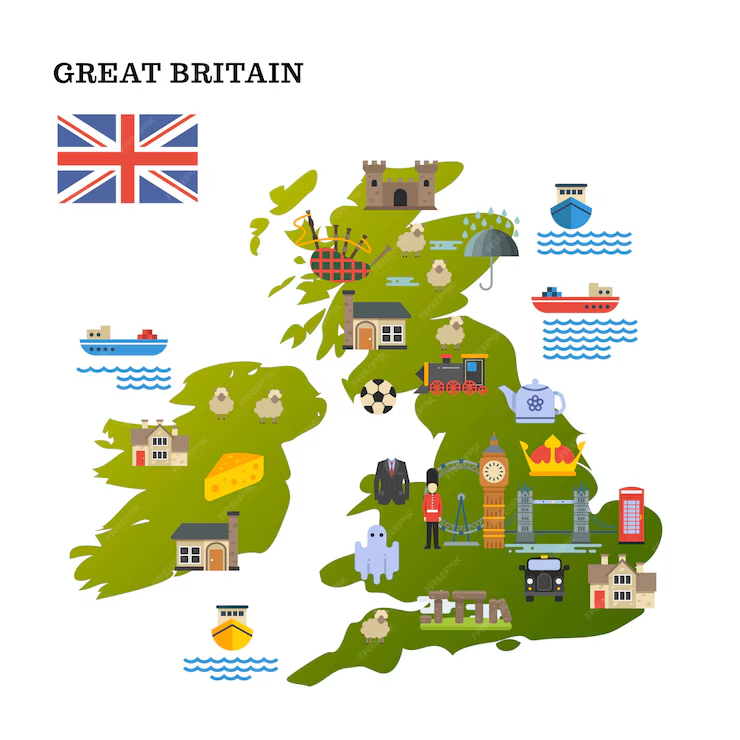
Cavity wall insulation can significantly improve the energy efficiency of your home and reduce your heating energy bills. However, the location of your home does impact your ability to receive free wall insulation.
This is mainly due to the severe exposure to wind-driven rain. This particularly affects the west side of the country, in England, Wales, and Scotland.
However, other forms of wall insulation are available, which can also aid in making your home energy-efficient, including internal solid wall insulation, internal wall insulation, or external wall insulation as well as free loft insulation.
Can I Get Cavity Wall Insulation for Free even if I’m Not on Benefits?
Individuals can get wall cavity insulation grants because of the GBIS and ECO4 scheme, as previously mentioned.
Unfortunately, housing association tenants do not qualify unless they own 50% of their rented home, though it could be beneficial to contact UKES anyway to see what we can do!
Frequently Asked Questions
Cavity wall insulation involves filling the gap between the inner and outer walls of your home with insulating material to reduce heat loss and improve energy efficiency.
The insulation material is injected into the cavity, creating a barrier that prevents heat from escaping through the walls, keeping your home warmer in winter and cooler in summer.
Benefits include reduced energy bills, improved home comfort, lower carbon emissions, and increased property value.
Homes built after the 1920s with uninsulated cavity walls are typically suitable. A professional assessment can determine your home’s eligibility.
Installation usually takes just a few hours for a standard home, but it may vary depending on the size and complexity of the property.
Yes, it is safe. The materials used are non-toxic and designed to last for many years without causing any damage to your walls.
The process is minimally invasive, typically done from the outside with little to no disruption to the interior of your home.
Properly installed cavity wall insulation should not cause dampness. It’s essential to use qualified installers to avoid any potential issues.
Costs vary depending on the size of your home and the type of insulation used. Government grants or funding schemes may be available to help cover the costs.
On average, cavity wall insulation can save you around £150 to £250 per year on energy bills, depending on the size and energy efficiency of your home.
Yes, there are government schemes such as the ECO 4 grant that provide financial assistance for cavity wall insulation to eligible households.
You can apply through approved insulation providers or via government energy efficiency schemes. Contact a local provider for an assessment and to begin the application process.